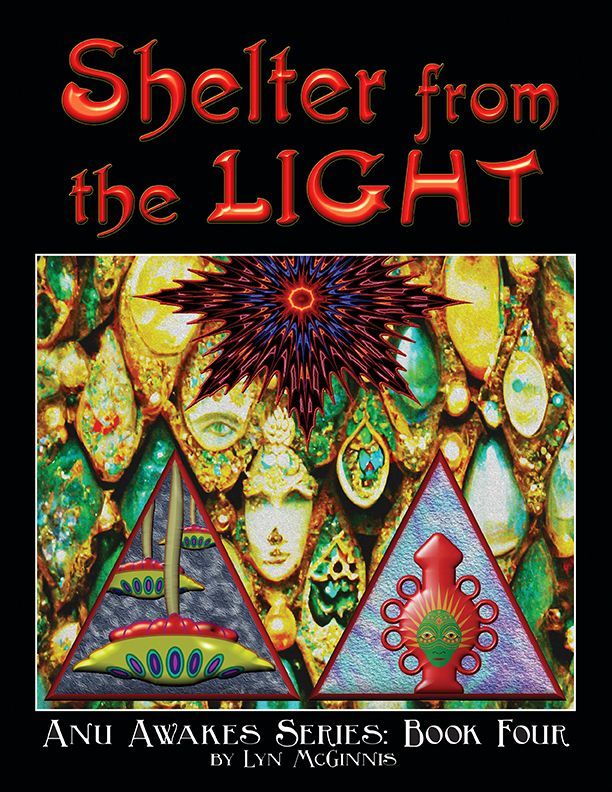
This is the page for the fourth Circle-of-Eight novel of the Anu Awakes Series. It will be under construction until early 2027; once it is complete, the book will also become available.
Welcome to the page set aside for the fourth novel in this series, set on the Tatchlan System's planet Anu. Over forty-eight thousand years have passed since the previous book, ‘Dalinantu Emergence.’ It is the year 97,199 of what later would be known as the Nantu Age (see fifth novel), and 145,918 of the Unbroken Koru Calendar (UKC). As detailed below and elsewhere, an immense series of events crowded this period. Two Cluster-of-Clusters Nations now occupy more than half of Anu’s lands. Much was achieved together while the growing depth and diversity of the Danam Yelda slowly came into greater prominence. All of this glory was humbled by the Mother of all Non-Living Banes, the Burning Blossom. While each novel has made a passing reference to this dreaded series of events, this middle book faces it directly. While much will be said about its origins and how its cycles manifest, those who want a full treatment of this defining cataclysm of the Anu Awakes Series are directed to the Burning Blossom Page on this site.
Background
Two Majastas Hands fulfilled, Full Maturation, Beneficial Derivations, The perfection of Tatchlan eclipsed by the Burning Blossom, Burning Blossoms in the Secondary Epoch, Surveyors General, Stone Harmonics and Jesplace, Deep Domains Epochal Generational Plans, First Cycle, Second Cycle, Third Cycle sees the Venerable Koru and their Majestic Living Mountains mortified,
Two Majastas Hands fulfilled
During this novel, the current Majastas House and the eleventh Danam Yeldic Majastas dynasty is the Hertamasa. The current ‘Supreme Operant’ is Hertamasa the Nineteenth. The Danam Yeldic Cluster-of-Clusters Nation has long possessed the entire subcontinent of Statos-Vey. The extended series of Epochal Generational Plans, now collectively known as the ‘Two Majastas Hands,’ is fulfilled. The Danam Yeldic Majastas surveys the day, and the Venerable Koru Majastas the night. This Danam Yeldic Age has seen eleven dynasties and one hundred and fifty Majastas maintain the ‘Splendid Yeldic Body’ within the Living System of Tatchlan and upon the Skin of Anu. The entire population normally hovers around one billion, spread over the subcontinent and the southern shores of Rho-Jashun, up to the feet of the southern wall of the Mulungu Mountains. These are housed within roughly one million clusters, with the cluster percentages remaining well within standard. This remarkable consistency in cluster percentages despite many vicissitudes due to climate and other non-living factors, signals the health and vigour of the Splendid Yeldic Body.
Full Maturation
Eighty provinces and provincial centres are connected by twenty-seven surface, underground, and underwater transit lines spanning the subcontinent and the southern coast of Rho-Jashun. Here, within the shadow of the southern range of the Mulungus, their transit system connects to the Koru’s ‘Continental Lines’ on the huge continent of Rho-Jashun. This opens access to the ancient processions of the fabled ‘Living Mountains,’ and, far beneath their mighty roots, the Koru’s Deep Domains. Over sixty thousand years ago, in 85,642 UKC, Majastas Dreamer Sheshisana the Sixth determined the Danam Yeldic Cluster-of-Clusters Nation had reached its territorial and population zenith and would expand no further. The Koru Majastas hailed this as a sign of the Danam Yelda’s ‘Full Maturation.’ While hundreds of thousands of notable events have taken place during this Danam Yeldic Age, most members of the ‘fleeting generations’ have lived peaceful, productive lives within their clusters, encirclements, and provincial centres.
Beneficial Derivations
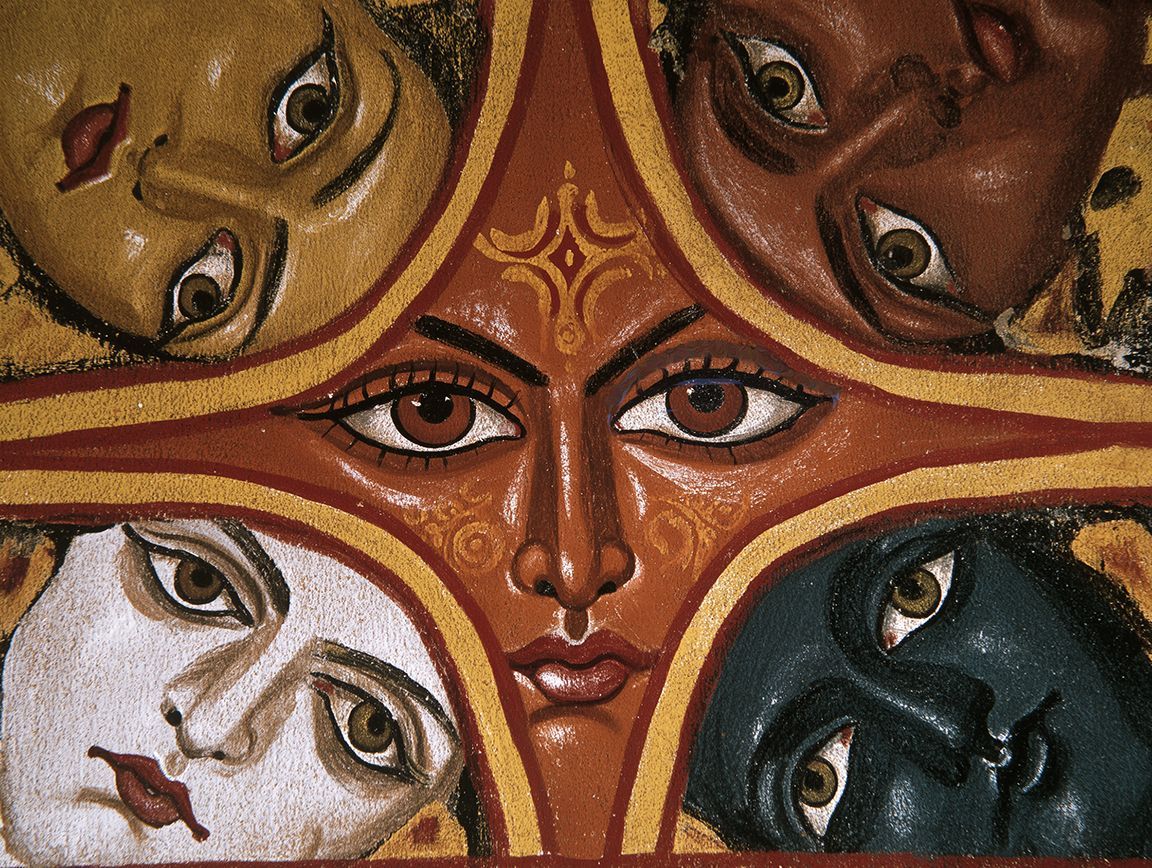
This small section of a well-preserved Nantu Age fresco illustrates Yelda's five classes. The bottom left and right show two primary branches of the Koru Yelda, the Sumudin and Kudurapala. The top left and right show the Yakku Yelda and ‘Field Yelda’ on the Marachla Plain of Rho-Jashun. The middle image shows the Danam Yelda and illustrates some of their ‘Beneficial Derivations’.
Notwithstanding the profound nature of all these developments, far greater changes took place within the bodies of the Danam Yelda. While the Koru Yelda, Yakku Yelda and what are still referred to as ‘Field Yelda’ of the Marachla Plain resemble the body structure and abilities of the Foremost Ones, the Tolku, the Danam Yelda have grown with mighty patience into something more. One aspect of these successive and incremental steps to greater depths is collectively termed ‘Beneficial Derivations.’ Several examples of these distinctions, which separate them from all branches of Koru and Yakku Yelda, will appear in this and subsequent novels in the series. They range from intensified skin patterning according to their Aroma Accord to a unique ability of circles and entire clusters to access Tatchlan through what is now celebrated as the ‘Spinning Wheel Dance.’ The Spinning Wheel initially appeared among the Field Yelda (see final chapter of Amarel Mountain) as a cluster bonding ritual. Over many millennia, it swelled into an effusive portal to Tatchlan itself. The Venerable Koru followed the blossoming of these derivations with profound attention. Their Operants observed and conversed with their Danam Yeldic Operant counterparts and others to better appreciate these emergent novelties.
The perfection of Tatchlan eclipsed by the Burning Blossom
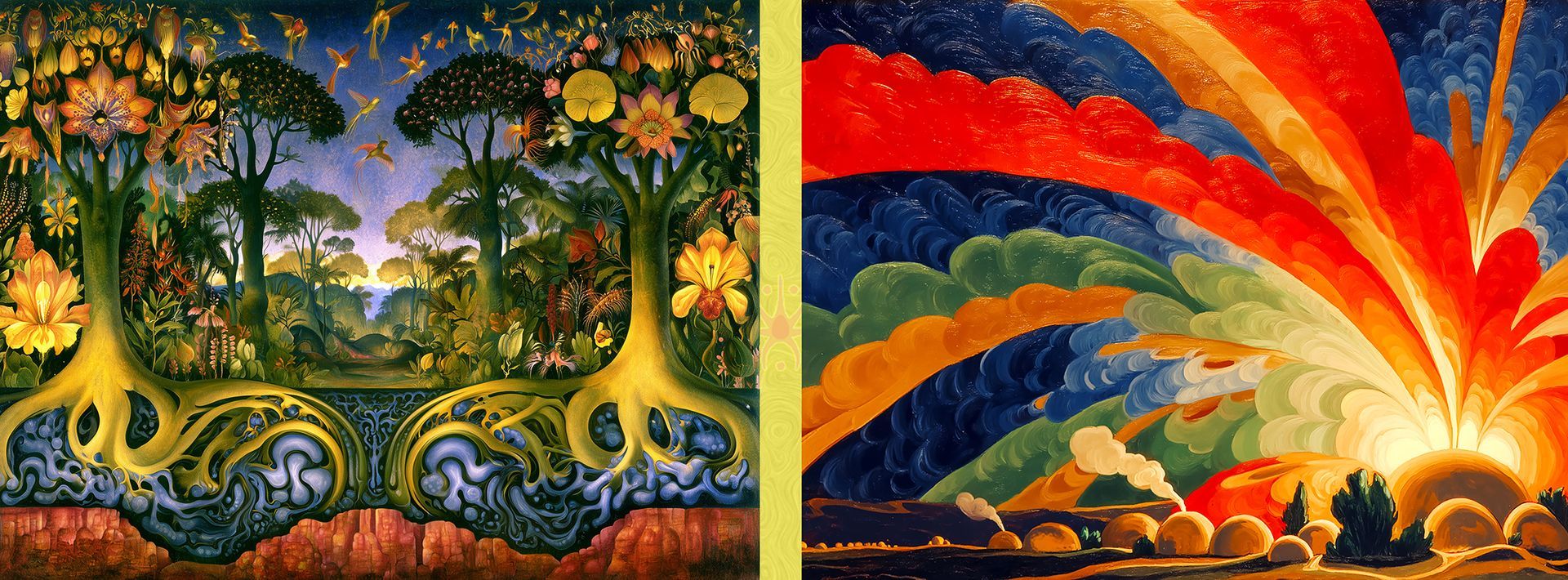
These two renderings illustrate the strengths and weaknesses of all Cluster-of-Clusters Nations. The first shows the Skin of Anu, which refers to the upper reaches of the air descending to the surface and extending below ground until it ends in dead rock. Below the surface is also called the ‘Flesh of Anu.’ The lowest is considered the richest and the highest the poorest in life, hence the term “The air is thin and empty. The loam is rich and full.” The entire Tatchlan System resides within the Skin and Flesh of Anu. The second is of the Full Burning Blossom. Public art of this horror during the Secondary Epoch was largely unknown during the Nantu Age of the Danam Yelda, where this novel is situated. Only with the establishment of the Upata Bulb as the protective cluster residence during the Emaxul Age was an unspoken taboo lifted, and renditions were made then and after these exceedingly rare occurrences. This will be the setting of the Sixth novel of this series. The Venerable Koru, far more vulnerable to this terrible Crown of all Non-Living Banes, seldom depicted this moment when all civilization, and even Tatchlan itself, were largely helpless before this event.
The Living System of Tatchlan envelopes the Skin of the Planet Anu. It has no hold over the dead rock far below the surface, or the ‘thin air’ high above it. The Koru and Danam Yeldic Cluster-of-Clusters Nations are profound manifestations of Tatchlan on the Skin of Anu, possessing both the Living System's strengths and vulnerabilities. While there are many ongoing challenges within this realm of life for Tatchlan to monitor, there remain the defiances of good order brought about by non-living occurrences, over which it has no sway. See the Non-Living Banes page for a listing of these unusual events. While some are neutral or even beneficial, most are scourges requiring either heroic measures or meagre relief afterward. Chief among these Banes is the Burning Blossom itself.
This novel takes place during the Sixth and final Cycle of the Second Burning Blossom Series of the Secondary Epoch. What follows summarizes the first five cycles, with particular emphasis on the Third Cycle, which led the Venerable Koru to abandon their Majestic Living Mountains in 141,828 UKC.
Burning Blossoms in the Secondary Epoch
The Secondary Epoch commenced with the Tatchlan Mantle enveloping the feet of the twenty-nine-year-old Koru Maja Woman who would become the first Majastas of the Koru Cluster-of-Clusters Nation, Zudaz-Vozev, or Majastas Zudaz the First. Her reign and legacy are the backdrop of the second novel of this series, Amarel Mountain, which begins with news of her unexpected death in the year 286 UKC. In the year 18,206 UKC, during the reign of the First Majastas of the Fourth Koru Majastas Dynasty, the Proponum, the first early warning signs, including strange births and weather, suggested a new Burning Blossom Cycle, the first full series of the Secondary Epoch, was imminent. By then, extensive records from the famed Treasuries and other sources outlining the history of the Blossom and Burning Blossom as it grew during the Primary Epoch were well known. Twelve years after these initial signs, in the year 18,218 UKC, the first Cycle of rainbow emanations appeared around the Eye of Nu. It commenced during the three hundred and tenth year of sovereignty for Koru Majastas Proponum the First. It was seen as a test of the Kupat, Ronthum and Xaduth Living Mountain Series of Rho-Jashun to protect the burgeoning Koru Cluster-of-Clusters Nation. Initially, these mighty structures were an effective defence against this Bane, to which the Koru were far more vulnerable than either the Yakku or Yelda. This First Burning Blossom series contained six cycles, with an average of two thousand three hundred years between them, over eleven thousand years. Readers of the third novel in this series, Dalinantu Emergence, may recall that this was the Burning Blossom series the first Yeldic population of Tich-Tushmul Island successfully weathered. This was noted in ancient reports referred to by both the Submissively Venerating of the Statos-Vey Protectorate and the Tich-Tushmul Task Force.
Surveyors General, Stone Harmonics and Jesplace
In 134,726 UKC, Koru Majastas Ohonomach the Fifteenth instructed Her Circulation and Irrigation Bureaus of the Dallamaplan’s Preeminent Works Ministry to employ their Venerable Scholars and Honoured Historians to do an exhaustive examination of all archived reports from the Surveyors General offices and generations of Land Steward clusters of both the Marachla Plain and the Mulungu Mountain chain. At the same time, current holders of the Surveyors General office were to rapidly expand and fan out across much of Rho-Jashun. The aim of all these endeavours was not to examine the ‘Skin of Anu,’ but the ‘Flesh’ beneath. It had long been known that Rho-Jashun had deep caverns and immense underground rivers flowing into ‘bottomless lakes’ many andas beneath the surface. Along with these measures, all current Masters of Stone Harmonics were deployed to various locations to seek and map this subterranean world. It was these ‘Stone Assayers’ who found themselves unwittingly resolving an ancient dispute over what had been deemed fantastical literature found in the most-ancient Treasuries, claiming an entire world of flora and fauna, collectively named ‘Jesplace,’ dwelt in the inky blackness. Their discovery also clarified certain aspects of the Living System, represented by this additional layer of life far below.
Deep Domains Epochal Generational Plans
Over the following millennia, several Generational, Perennial, Targeted and finally Epochal Generational Plans were enacted. The cumulative result was a vast endeavour to expand these enormous caverns and form huge networks linking existing underground cavities beneath the Marachla Plain and Mulungu Mountain Chain on the continent of Rho-Jashun, as the ultimate protection against the Burning Blossom's eventual return. In the short term, the most sensitive spokes, and those clusters and circles designated as one or more of the Eight Living Jewels, would be dispatched to these sanctuaries when the Cycles returned. The ultimate aim was to create what would become known as the Deep Domains, so the Koru Cluster-of-Clusters Nation could shelter from the Burning Blossom and then live the life they increasingly craved, deep within the Flesh of Anu.
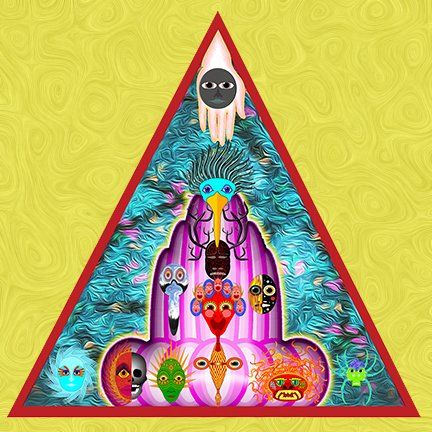
This is the Koru icon for their Deep Domains. A Ketukku-inspired mound and tower complex rises within a deep cavern, festooned with all Twelve Faces of the Tatchlan Living System. The pale Koru White Hand descends from above, holding the Face of Balance and the bridge between all things, Alatanda. This icon speaks of contentment and completion for the Koru. They continue as the Guardians of the Tolku Legacy, the Upper Abyss's outer chaos, and the Deep Domains' lower harmony. Their Majastas continue to link to the Sensitives of all classes on the surface of Rho-Jashun, being both the Yelda and Yakku covering the Marachla Plain and inheriting their vast legacy of the Living Mountain Series. Just below the Koru Hand is the visage of Vashivonos, ‘The Face of Necessity,’ which is more pronounced than all the other faces in this icon.
First Cycle of the Second Burning Blossom Series
The first Cycle of brilliant rainbow ‘Emanations' appeared around the Face of Nu in 137,107 UKC. This began the Second Burning Blossom Series of the Secondary Epoch. The Ceremonial Walk of the Danam Yelda outlined in the third novel of this series, ‘Dalinantu Emergence,’ is ancient history (The eighty-thousandth anniversary of this same Ceremonial Walk from Dalinantu to Upata-Shepsus was conducted by Majastas Complete Kutran-Kamos XXI in 128,558 UKC).
The First Burning Blossom Series of the Secondary Epoch (long before the Danam Yelda existed) had included six distinct cycle events, spanning eleven thousand eight hundred and seventy-one years, beginning in 18,218 and ending in 30,089 UKC. About two thousand years separated each event. That series ended 107,018 years earlier.
This First Cycle of this Second Series lasted seven days. For the Danam Yelda, the event was relatively benign. The Venerable Koru felt this same series far more keenly. The Koru Majastas Ohonomach the Twentieth, of the fifteenth dynasty of the Koru’s Cluster-of-Clusters Nation, deployed an unlikely defence: the Kanart Mushroom. They had seeded it on the inner walls of the Koru’s Living Mountains back when the imminence of this Cycle became apparent (see Singing Mounds and Foreign Rain incidents). This, added to their already formidable non-living barriers, proved sufficient to defend most Koru clusters and encirclements against this First Cycle. This early warning also allowed for the successful transport of many hundreds of thousands of all Eight Living Jewels of the Koru to be safely housed in the early habitats of the Deep Domains. This new series of Blossom Events also commenced during the Tenth Dynasty of the Danam Yelda, during the reign of Majastas Thamuzana the Sixth. In this First Cycle, non-living barriers were still adequate to protect the Danam Yelda, although incidents of various aberrations in a wide variety of living beings, and Nu Sickness among the Danam Yelda themselves, became widespread after the Cycle ended. This was later judged, in part, to be due to insufficient care by some clusters, presuming natural immunity.
Second Cycle of the Second Series
The Second Cycle began 2,212 years after the first cycle of this series, during the reign of Koru Majastas Ohonomach the Twenty-Fourth and Danam Yeldic Majastas Hertamasa the Second in 139,319 UKC. As happened in most-ancient times, this five-day cycle is stronger than the first. Beyond general fright and disturbance among awake and other creatures, this event still had little sustained destructive power for the Danam Yelda. Despite old and new defences, this same event caused more suffering and death among the Koru, who were far more sensitive to Nu’s depredations than all classes of Yelda or Yakku. This was mitigated somewhat by another Koru innovation to fortify the Venerable Koru: the measured use of treasured Multitude Blood. The Danam Yelda perfected this process for subsequent cycles, although for the next two cycles they remained relatively unaffected because stronger protocols limited exposure during the event.
Koru Majastas Ohonomach XXIV and then Ohonomach XXV worked to deepen and expand the Deep Domains many andas beneath the ‘Boundless Marachla Plain.’ It was later estimated that this labour was equivalent to what had been required for the twenty-two Kupat Series, the forty-five Ronthum Series, and the eighty-one Xaduth Series of Living Mountains. These three cumulative series of massive structures had taken over 20,000 years to complete. Notwithstanding all previous generational work, it was foreseen that completing this colossal set of interior environments, with their attendant living amenities and vital transit and other infrastructure, would take nearly as long. Such was the hold of the Living Mountains that, even though all knew the Third Cycle would break upon them, most of the Koru Cluster-of-Clusters Nation remained within what had been, for so many generations, a core part of their identity.